
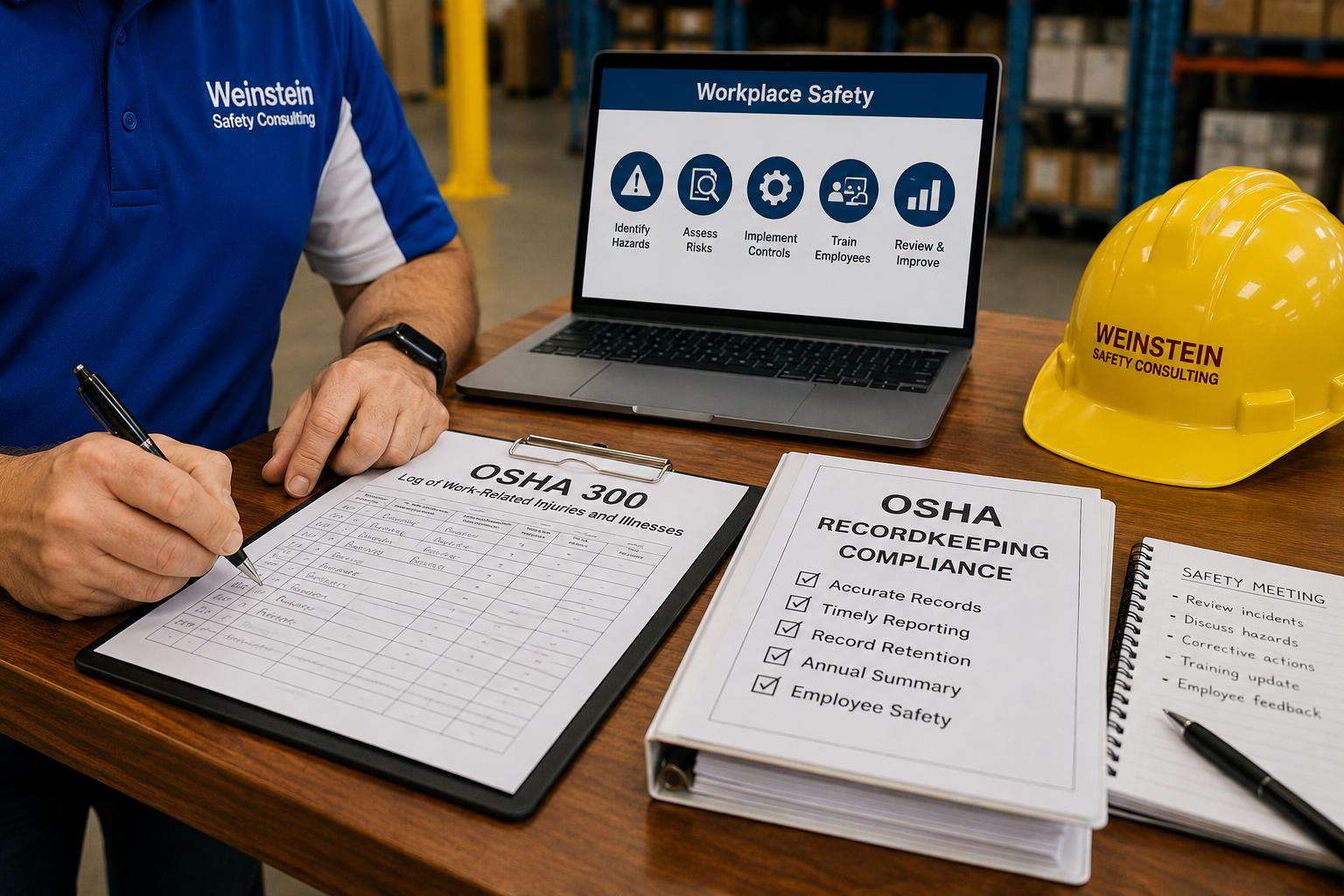

OSHA Recordkeeping Requirements: What Employers Need to Know in 2026
A practical guide to OSHA Forms 300, 301, and 300A, recordability decisions, posting and retention deadlines, electronic submission, severe-injury reporting, common mistakes, and inspection readiness.
OSHA recordkeeping can look like an administrative requirement until an injury occurs, an OSHA inspection begins, or someone discovers that a case was recorded incorrectly. For employers in construction, manufacturing, warehousing, industrial operations, and other higher-risk workplaces, accurate injury and illness records are part of the larger safety system—not just paperwork.
OSHA's recordkeeping requirements under 29 CFR Part 1904 establish which employers generally must maintain injury and illness records, which cases are recordable, how long records must be retained, when the annual summary is posted, and when certain establishments submit information electronically.
The most common mistake is using intuition instead of the rule. Not every workplace injury is automatically recordable, and a case does not need to look severe to meet OSHA's recording criteria.
What Is OSHA Recordkeeping?
OSHA recordkeeping is the system covered employers use to document qualifying work-related injuries and illnesses. The three forms most often associated with the process serve different purposes.
OSHA Form 300
Running log of recordable work-related injuries and illnesses. Cases are classified and tracked during the year.
OSHA Form 301
Provides additional details about an individual incident and is generally completed for each recordable case.
OSHA Form 300A
Annual summary of recordable cases. It must be certified by a company executive and posted when applicable.
Employers can review OSHA's official injury and illness recordkeeping forms when verifying current form requirements.
Recordkeeping and severe-injury reporting are separate obligations. A company can be partially exempt from routine OSHA logs and still have a duty to report a qualifying fatality, hospitalization, amputation, or loss of an eye.
Who Has to Keep OSHA Injury and Illness Records?
Not every employer is required to routinely maintain OSHA Forms 300, 301, and 300A. Certain employers with 10 or fewer employees during the previous calendar year are partially exempt, and some establishments in designated lower-hazard industries are also partially exempt.
Do not decide exemption status based on company size or industry assumptions alone. Confirm the requirements that apply to the specific establishment.
What Makes an Injury or Illness OSHA Recordable?
A workplace incident does not become recordable merely because something happened at work. Employers should work through the decision in a consistent order.
Did an Injury or Illness Occur?
Start with whether there is an injury or illness to evaluate under Part 1904.
Is the Case Work-Related?
Determine whether the event or exposure meets OSHA's work-relatedness rules.
Is It a New Case?
New cases and recurrences can require different treatment under the recordkeeping rule.
Does It Meet a Recording Criterion?
Evaluate days away, restricted duty, job transfer, medical treatment beyond first aid, loss of consciousness, and qualifying diagnoses.
A work-related case generally becomes recordable when it results in death, days away from work, restricted work or job transfer, medical treatment beyond first aid, loss of consciousness, or a significant injury or illness diagnosed by a physician or other licensed health care professional.
First Aid vs. Medical Treatment: Why the Difference Matters
OSHA defines specific treatments that count as first aid for recordkeeping purposes. Employers should not create their own informal definition. A clinic visit does not automatically make a case recordable, and calling something “first aid” internally does not make it first aid under Part 1904.
| Recordability Question | Why It Matters |
|---|---|
| Was the event or exposure work-related? | Recordkeeping generally begins with work-relatedness. |
| Is this a new case? | Recurrences and new cases can require different analysis. |
| Was there medical treatment beyond OSHA-defined first aid? | This can make an otherwise qualifying case recordable. |
| Were days away from work involved? | Days-away cases are recordable. |
| Was work restricted or was the employee transferred? | Restricted work or job transfer may trigger recording. |
| Was there loss of consciousness? | Loss of consciousness is a general recording criterion. |
Document the decision when the answer is not obvious. A short written explanation made while the facts are fresh is far more defensible than reconstructing the reasoning months later during an inspection.
Key OSHA Recordkeeping Deadlines
7 Seven Calendar Days
Covered employers generally enter recordable cases on the OSHA 300 Log and Form 301 within seven calendar days after receiving information that a recordable injury or illness occurred.
5 Five-Year Retention
Covered employers generally retain the OSHA 300 Log, privacy case list when applicable, Form 301 reports, and Form 300A summaries for five years following the year they cover.
A February 1–April 30
Covered establishments generally post the previous year's certified Form 300A annual summary during this period.
I Electronic Submission
Certain establishments must submit injury and illness data through OSHA's Injury Tracking Application during the annual submission window.
OSHA's current recordkeeping guidance summarizes posting, retention, and electronic-submission requirements.
Does OSHA Require Electronic Submission?
Some establishments must electronically submit injury and illness information through OSHA's Injury Tracking Application. The requirement depends on establishment size, industry, and the current electronic-submission rule. Certain establishments submit Form 300A information, while some larger establishments in designated industries must also submit information from Forms 300 and 301.
Because electronic-submission requirements have changed over time, employers should verify the current rule rather than relying on an old checklist or a prior year's assumption.
OSHA Recordkeeping vs. OSHA Reporting
Recording
Recording generally means entering qualifying cases into required injury and illness records such as Forms 300, 301, and 300A.
Reporting
Reporting means notifying OSHA directly about certain severe work-related events, including fatalities, in-patient hospitalizations, amputations, and losses of an eye.
Federal OSHA timing: a work-related fatality is generally reportable within 8 hours, while a work-related in-patient hospitalization, amputation, or loss of an eye is generally reportable within 24 hours.
See OSHA's current severe-injury reporting information when confirming a reporting obligation.
Common OSHA Recordkeeping Mistakes
OSHA has defined criteria. Apply the rule rather than recording every event automatically.
The location where treatment occurs does not decide recordability by itself.
The systems serve different purposes. A workers' compensation determination does not automatically decide whether a case belongs on the OSHA log.
Waiting until year-end makes it harder to reconstruct medical treatment, restrictions, days away, and case updates accurately.
How OSHA Records Can Improve the Safety Program
The OSHA log is primarily a required recordkeeping document, but the information behind it can help management identify repeated tasks, departments, employee groups, equipment, or injury types that deserve closer attention.
What Employers Should Review Before an OSHA Inspection
An OSHA inspection can involve more than a facility walk-through. Depending on the scope, a compliance officer may review injury and illness records along with written programs, training documentation, and workplace conditions.
Weinstein Safety Consulting's OSHA compliance and inspection support includes review of OSHA logs, injury and illness records, reporting procedures, safety documentation, and inspection-readiness gaps.
Build a Better Recordkeeping Process
A strong recordkeeping system does not need to be complicated. It needs to be consistent, clearly assigned, and connected to the broader safety process.
Employers needing broader support can also review Weinstein Safety Consulting's safety consulting services for workplace assessments, written safety programs, training, OSHA inspection preparation, and ongoing compliance guidance.
Frequently Asked Questions
Do all employers have to keep an OSHA 300 Log?
No. Certain small employers and establishments in designated lower-hazard industries are partially exempt from routine OSHA injury and illness recordkeeping. Employers should verify the requirements that apply to their specific establishment.
Is every workers' compensation claim OSHA recordable?
No. Workers' compensation eligibility and OSHA recordability are separate determinations. Apply OSHA's Part 1904 criteria when deciding whether a case belongs on the OSHA log.
Does going to urgent care make an injury OSHA recordable?
Not automatically. Evaluate work-relatedness, whether the case is new, the treatment provided, and OSHA's other recording criteria.
How long do employers keep OSHA 300 records?
Covered employers generally retain required injury and illness records for five years following the end of the calendar year they cover.
When is OSHA Form 300A posted?
Covered establishments generally post the annual summary from February 1 through April 30 for the previous calendar year.
Can Weinstein Safety Consulting review our OSHA records?
Yes. Weinstein Safety Consulting provides OSHA compliance and inspection support, workplace assessments, written safety-program development, documentation review, and practical guidance for employers in Greater Phoenix, the West Valley, and Michigan.
Make Recordkeeping Part of the Safety System
OSHA recordkeeping should not be a once-a-year administrative exercise. Accurate records support regulatory compliance, inspection readiness, hazard identification, corrective action, and better decisions about workplace risk.
If your OSHA logs, recordability decisions, posting practices, electronic submissions, or severe-injury reporting procedures have not been reviewed recently, Weinstein Safety Consulting can help identify and correct gaps before they become inspection findings.
About Phil Weinstein, MS, CSP
Phil Weinstein is the founder of Weinstein Safety Consulting and a Board-Certified Safety Professional with more than 32 years of occupational safety and health experience. His work includes OSHA compliance, inspection preparation, industrial hygiene, hazardous waste, respiratory protection, written safety programs, workplace assessments, and employee training for employers in Arizona and Michigan.